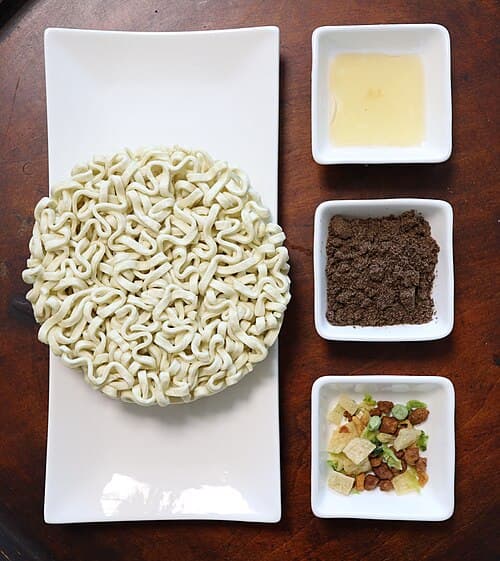
Nongshim · Black bean noodles
·★4.9(177 reviews)Chapagetti
짜파게티 (Jjapageti)
Instant jjajangmyeon: glossy black bean noodles with zero spice.
- Heat
- 0/5
- Cook
- 5′
- Water
- 600ml
- Calories
- 610kcal
What Chapagetti tastes like
Chapagetti is an instant take on jjajangmyeon, the Korean-Chinese black bean noodle dish. Instead of a soup, you drain the noodles and toss them with a dark seasoning powder and a little oil. The sauce is sweet, salty and savory, with the roasted, slightly smoky taste of chunjang (black bean paste) and a mellow onion flavor. There is no chili at all. It tastes rich without being heavy, and the leftover sauce at the bottom of the bowl is very good with rice.
The noodles are medium-thick and cook up soft with a light chew. Because they are drained and stir-fried briefly in the seasoning, the texture comes out more like a sauced pasta than a soup noodle. The key is how much water you leave behind. Too much and the sauce turns watery and pale; too little and it clumps and tastes too salty. Getting it right gives glossy noodles evenly coated in sauce.
In Korea, Chapagetti has been a household favorite for decades, and Sunday is jokingly known as the day to cook it, thanks to an old television ad. Kids love it because it is sweet and not spicy. It became globally known after the 2019 film Parasite, where it was mixed with Neoguri to make jjapaguri, translated as ram-don in English subtitles. Most Koreans eat Chapagetti with danmuji or kimchi, the same sides you get with restaurant jjajangmyeon.
Choose Chapagetti if you do not eat spicy food, or if you are cooking for children or picky eaters. It is also a great pick for anyone who loves savory-sweet flavors like teriyaki or hoisin. If you have never had real jjajangmyeon, this is a friendly introduction, though restaurant versions are saucier and use fresh noodles. Spice lovers can add chili flakes, or mix in some Neoguri for the famous combination.
How to cook it
Based on typical package directions (about 600 ml water, 5 minutes). Recipes vary by country, so check your package.
- 1
Bring about 600 ml of water to a boil.
- 2
Add the noodles and the vegetable flakes and cook for about 5 minutes, stirring once or twice.
- 3
Drain the water, leaving about 8 tablespoons (roughly 120 ml) in the pot with the noodles.
- 4
Add the seasoning powder and the oil packet.
- 5
Stir-fry over low to medium heat for about 30 seconds, until the sauce thickens and coats every strand.
- 6
Plate and serve right away with danmuji or kimchi on the side.
How to make Chapagetti even better
Fry an egg on top
A sunny-side-up egg with crispy edges is the most common Chapagetti upgrade in Korea. Fry it in a little oil while the noodles boil, then lay it on top. Break the yolk and mix it in; the runny yolk makes the black bean sauce silkier and slightly richer.
Add a slice of cheese
Put a slice of cheese on the hot noodles right after stir-frying and let it melt for a minute before mixing. The salty, creamy cheese plays well with the sweet black bean sauce. Start with one slice; more can make the dish heavy and hide the roasted chunjang flavor.
Stir-fry onion and pork first
For a bowl closer to restaurant jjajangmyeon, stir-fry half a diced onion and about 50 g of diced pork belly in a pan until golden, then add the drained noodles, seasoning and oil. The fresh onion adds sweetness and the pork fat gives the sauce body. Leave a spoonful or two more water than usual.
Use less water if it turns soupy
The most common mistake is leaving too much water. If the sauce looks thin and gray-brown instead of glossy black, keep stir-frying over medium heat for another 30 to 60 seconds to reduce it. Next time, drain a little more. Tilting the pot against a lid works better than a sieve for measuring.
Famous Hacks Using Chapagetti
The Legendary Chapaguri (Ram-don)
김성주 & 윤민수의 짜파구리 (기생충 Ram-don)
💡 The Secret Kick
The golden ratio: 1 full pack of Chapagetti black bean seasoning plus exactly 1/2 (to 2/3) pack of spicy Neoguri powder.
On February 17, 2013, on MBC’s family camping reality show Dad! Where Are We Going?, broadcaster Kim Sung-joo cooked a mashup of sweet black bean Chapagetti and seafood-spicy Neoguri for 7-year-old Yoon Hoo.
Base Noodles
Hwasa’s Truffle Oil Egg Yolk Chapagetti
화사의 트러플 오일 짜파게티
💡 The Secret Kick
Pour three generous swirls of white or black truffle oil over a glossy plate of Chapagetti, capped with a fresh raw egg yolk.
On Episode 281 of MBC’s I Live Alone, MAMAMOO’s Hwasa woke up in the late afternoon and cooked instant black bean noodles. Instead of eating them normally, she plated the noodles, separated a raw egg yolk on top, and poured an extravagant amount of truffle oil over the entire dish.
Base Noodles
Related guides
Jjapaguri (Ram-Don) from Parasite: How to Make It at Home
Make jjapaguri, the Chapagetti and Neoguri mash-up from Parasite, at home: the seasoning ratio, water and timing, a budget version and a steak-topped version.
8 min read
How Koreans Actually Eat Ramyeon
From eating off the pot lid to Han River cooking machines and rice in the leftover broth, here is how Koreans really eat instant ramyeon day to day.
7 min read
6 Ways to Add Egg to Ramyeon (and When to Use Each)
Whole poached, swirled, half-broken, jammy, fried or a raw yolk: six ways Koreans add egg to ramyeon, with timings and which noodle style suits each method.
7 min read
Cheese Ramyeon: The Korean Snack-Bar Classic
How to make chijeu ramyeon like a Korean bunsik snack bar: which cheese melts best, which noodles to use, exact timing, and fixes for greasy or grainy soup.
7 min read